Concept Walkthroughs
A door is a job, not a category
 Ratik3 min read
A storefront built around one question instead of a product grid, with doors that are customer jobs rather than categories and an education hub joined to the products both ways.
Open most supplement storefronts and the first screen is the catalog. Three products, or three hundred, arranged in a grid with a navigation organized by format. It works for the visitor who already knows they want a powder. Everyone else is being asked to answer a question they came here to have answered.
The Storefront is a fictional concept built on a made-up store called PLAIN / LIVING. Products, prices and articles are sample content written for this concept, and no health claim is made anywhere in it.
What already works, before what does not
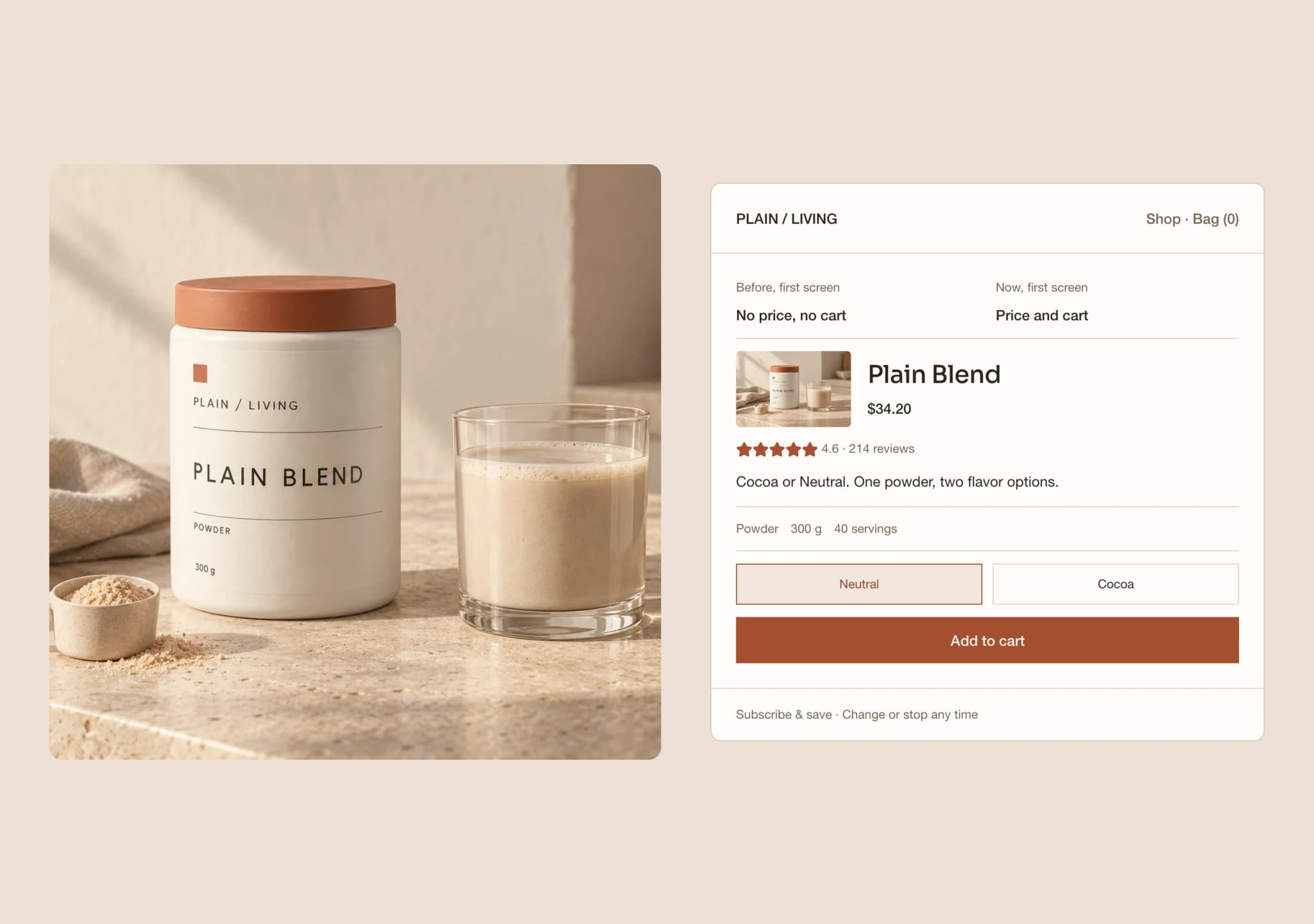
The current storefront is not a disaster and the rebuild does not pretend otherwise. The page is light, every product publishes its price, and the offer bar reads “Launch offer · first canister”. Those are worth keeping and worth saying out loud.
What does not work is narrower and more specific. The first screen is a grid. The navigation is by format rather than by what someone came for. The writing sits in a blog nothing links to. Nothing tells a first-time visitor where to start.
Leading with the failures would make the page read as a sales document. The point of an audit is that the merchant believes the numbers, and credit before critique is what buys that.
One question, before any product
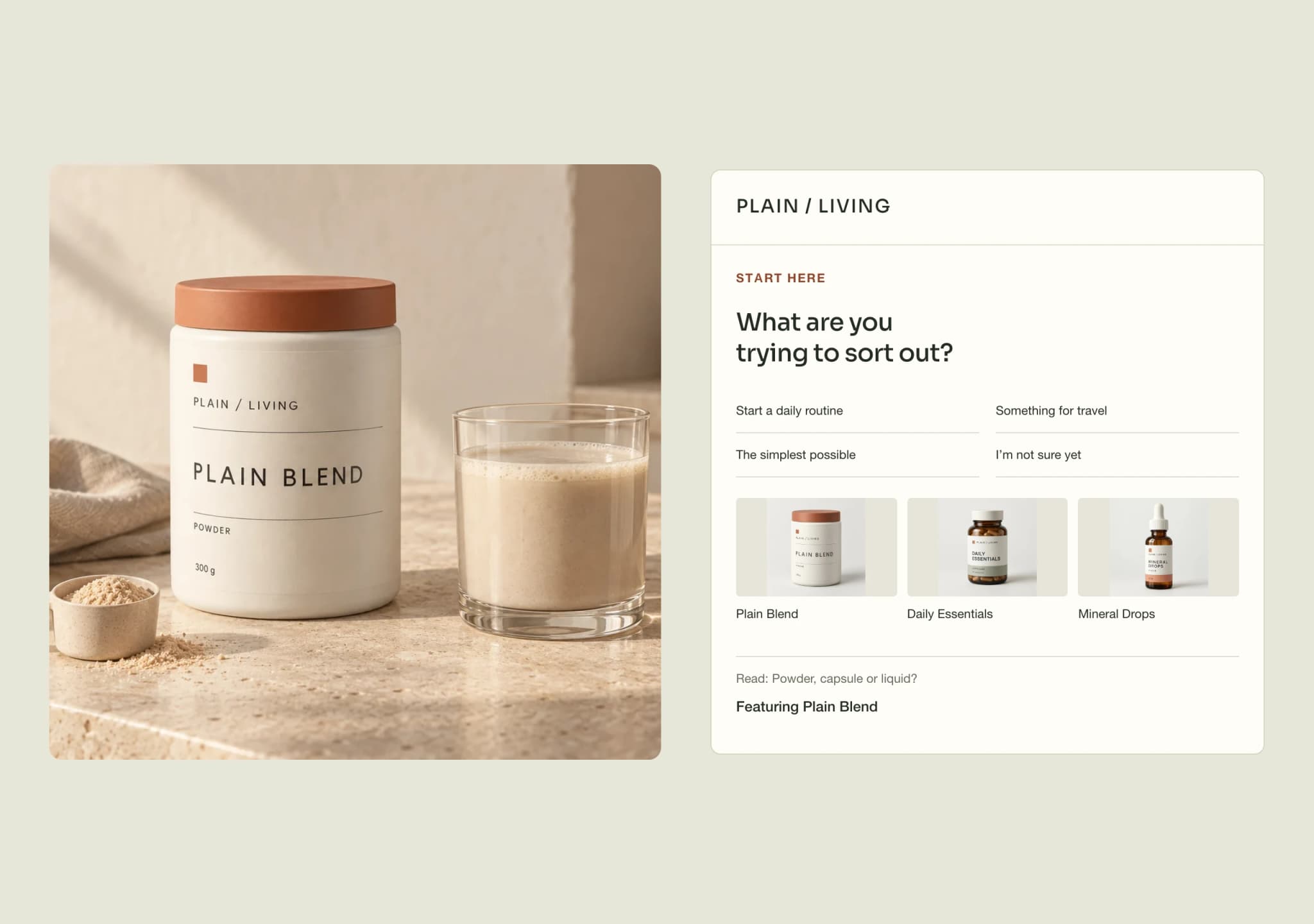
The rebuild opens on a question (what are you trying to sort out) with four ways in underneath it. Start a daily routine. Something for travel. The simplest possible. I am not sure yet.
The offer bar stays. The store’s own trust marks stay, in the store’s own words. Nothing about the brand is replaced; what changes is the order in which a visitor meets it.
The format navigation stays too. Powder, capsules and liquid still work perfectly for the person who already knows. The doors sit in front of that, not instead of it.
Doors overlap on purpose
A category is a property of a product. A door is a job somebody arrived with, and the same product can serve several jobs.
So two doors lead to the same canister, because two different mornings do. The capsule bottle sits behind both the routine door and the travel door. In a taxonomy that would be a tagging mistake. In a set of doors it is the entire idea, and the concept says so rather than hiding the overlap.
Every card carries a price and one line on what the product is for. A card without either is a product list wearing a different layout.
Join the writing to the shop, both ways
Most stores park the blog beside the shop. If anything links, it links one way: an article mentions a product, and the product never mentions the article.
Here every article names the product it is about, and every product card carries the writing about it. You can open a door, follow a product to its article, and follow the article back to the product. The demo tracks that loop, because the loop closing is the deliverable, not the prose and not the layout.
An education hub that cannot be reached from a product page is a content program. One that can be is merchandising.
What production would need
A real build starts from the store’s own catalog, its own writing and its own language for the jobs its customers arrive with. Four doors is right for three products; a larger range needs its doors researched rather than invented, and it needs a rule for what happens when a door would return forty things.
The doors also need measuring on their own terms. The useful question is not which door is clicked most, but whether the people who used one went on to find something, and whether the round trip between the writing and the shop is being walked at all.
A category tells you what a product is. A door tells you what somebody came for. Only one of those is a reason to build a first screen around it.
What would this look like for your brand?
Talk directly with a founder about one customer journey, the systems behind it and a focused prototype using your approved products and content.