Guides
What an agent actually needs from your store
 Ratik4 min read
ACP, UCP, AP2 and MCP address different workflows. Separate product discovery, checkout, payment authorization and tool access before choosing an integration.
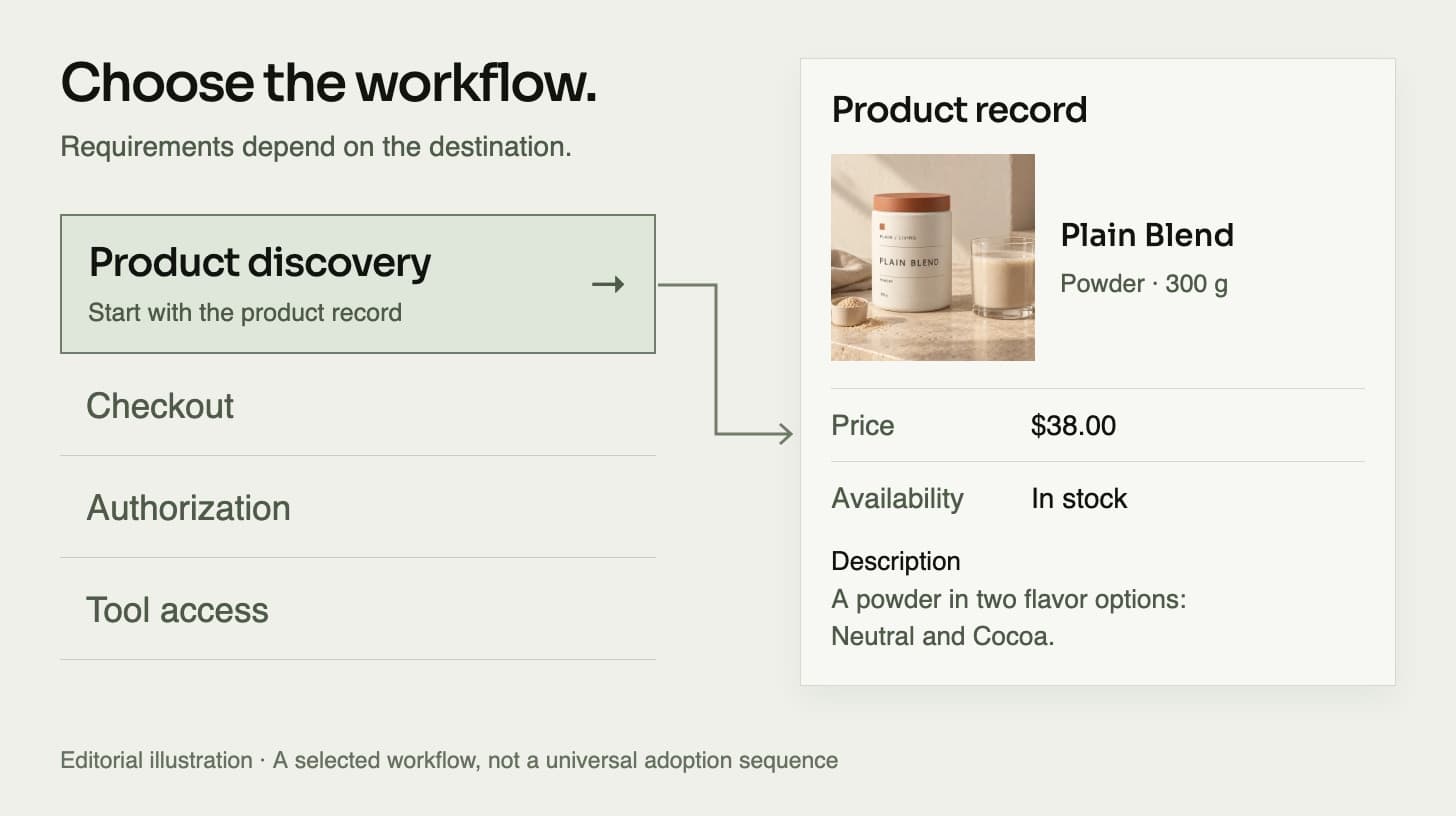
Almost everything written about agentic commerce runs four different things together. ACP, UCP, AP2 and MCP get listed as though a merchant has to do all four.
They address different layers, and responsibilities depend on the integration. Start with the workflow you need and the requirements published for that destination, not a deadline attached to an acronym.
ACP, the OpenAI and Stripe path
OpenAI’s documentation separates a product discovery feed from Instant Checkout. The three flows below describe its checkout integration, not three universal requirements for appearing in ChatGPT.
A product feed comes first: a secure, regularly refreshed feed in CSV or JSON carrying identifiers, descriptions, pricing, inventory, media and fulfillment options, with daily snapshots.
Then the agentic checkout endpoints: create and update a checkout session, validate it, determine fulfillment, calculate tax, process the payment, and accept or decline the order. These are real endpoints on your systems, not a hosted widget.
Then a payment path, through a designated payment service provider, or directly if you are a PCI DSS Level 1 merchant running your own vault.
Embedded presentation does not transfer order ownership: the merchant’s systems retain checkout state, validate the order and process payment. The merchant remains the merchant of record.
UCP, the Google path
The Universal Commerce Protocol covers AI Mode in Search and Gemini, and the requirements are more granular.
A product only shows a buy option if its listing carries the native commerce checkout eligibility attribute. That is set per product, and Google recommends applying it through a supplemental feed rather than editing the primary one. Return policies have to be defined in Merchant Center. Support contact details have to be provided. Each product needs an identifier that maps to the product ID your own checkout API uses.
There is also a Google Pay and Wallet Console account to set up, a payment provider that has integrated the Google Pay API, an interest form to submit, and an approval to wait for. At the time of writing it is available to select merchants in the United States, Canada and Australia.
UCP also describes post-purchase capabilities. A specification’s scope is not the same as every capability being enabled in a particular merchant integration; check the supported journey before promising it.
Source: Google Merchant Center: About the Universal Commerce Protocol
MCP is not the first thing to build
The Model Context Protocol is used for tool and data access. Shopify documents storefront tools for products and carts, and customer-account tools for authenticated customer workflows.
Use it when a defined workflow needs tool access to your commerce systems. Resolve inconsistent data before exposing it through another interface.
The sequence that actually makes sense
Product discovery and checkout need trustworthy product and operational data. Payment authorization and tool access add their own requirements; a complete catalog does not satisfy those by itself.
OpenAI’s Instant Checkout guidance calls for a regularly refreshed product feed. Stale values can leave that integration with outdated price or availability data; this does not mean the ACP specification itself stops working. Google’s UCP checkout integration requires return-policy information in Merchant Center, including its supported product-feed option. That requirement is specific to checkout on Google.
An MCP connection exposes the tools and data its server provides. It does not establish that product records agree or that the client will use every field it receives.
So the order is not controversial. Get the record right: one source of truth, fields that agree across page, structured data and feed, nothing important living only inside an image. Then publish the operational facts that the specifications ask for, which mostly means returns, shipping and support, written once in a form a machine can act on.
Choose the destination early enough to know which requirements apply. Build the connector when the workflow, permissions and underlying data are ready.
The useful brief names a journey, a destination and the work your systems must own.
Source: Google: Prepare Merchant Center for checkout on Google
Source: MCP: Architecture and scope
What would this look like for your brand?
Talk directly with a founder about one customer journey, the systems behind it and a focused prototype using your approved products and content.