AI in Practice
What AI shopping agents can read about your store
 Ratik3 min read
Product discovery and agentic checkout have different requirements. Start with accurate product facts and the documentation for your chosen destination.
Shopping Agents Are Already Buying
ChatGPT and Google support shopping experiences connected to merchant systems through ACP and UCP. The destination matters: product discovery, an embedded checkout and a handoff to your store are different integrations.
An assistant can help someone compare formats, prices and published product details before visiting your store. That does not tell you what every referred visitor asked, or whether the answer they received was accurate.
AI-referred traffic to US retail sites grew 393% year-over-year in the first quarter of 2026, according to Adobe Analytics. In March 2026 that traffic converted 42% better than non-AI traffic, and produced 37% more revenue per visit. A year earlier, the same measurement had it converting 38% worse.
Those are aggregate observations, not proof that AI sends the best visitors to every store or that a particular integration causes sales. Check your own referred sessions and landing pages before making that investment.
How Agentic Commerce Works
ACP and UCP connect shopping experiences to merchant systems. An assistant receives a shopping request, uses product data to compare options, and presents a recommendation. What happens next depends on the platform and the merchant’s supported checkout path.
Some integrations render checkout inside the assistant; others hand the shopper to the merchant’s site. An embedded checkout does not move order processing out of the merchant’s systems: the merchant still validates the order and handles payment. Discovery can happen in chat without the whole purchase happening there, so your product data and your own checkout both need to work.
Specific product facts are more useful to compare than “premium quality.” Publish the actual format, quantity and ingredients, and identify the evidence behind any certification. Keep visible copy, structured data and feeds consistent. None of those fields guarantees a recommendation.
What Makes a Store Visible
Three places are worth inspecting. They are not a universal eligibility checklist.
The first is the product page and its structured data. Use the fields required by the destination you are targeting, and separate required fields from recommended ones. Google’s AI search guidance does not require special schema or AI files. Do not invent identifiers, reviews or certifications to fill a checklist.
The second is feed freshness. Inspect the selected platform’s delivery requirements, update timestamps and validation errors. OpenAI documents daily snapshots for its product feed; “real time” is not a universal requirement. Recheck price and availability when the shopper reaches checkout.
The third is accessible answers to purchase questions: pack size, format, shipping and returns. Put important information in readable page text. FAQ markup is not a prerequisite for an AI citation, and a PDF is not automatically unreadable. Do not turn product guidance into an unsupported health claim.
What Most Stores Get Wrong
A schema plugin can produce valid markup without resolving contradictions between the page, feed and checkout. Validation and factual accuracy need separate checks.
Inspect what a shopper can verify and what the selected destination receives. A missing field is actionable when its requirement and source are known, not merely because an audit tool can count it.
Choose an integration for a defined customer journey. Accurate records are useful now; predictions about future ranking signals are not an implementation brief.
The Concrete Steps
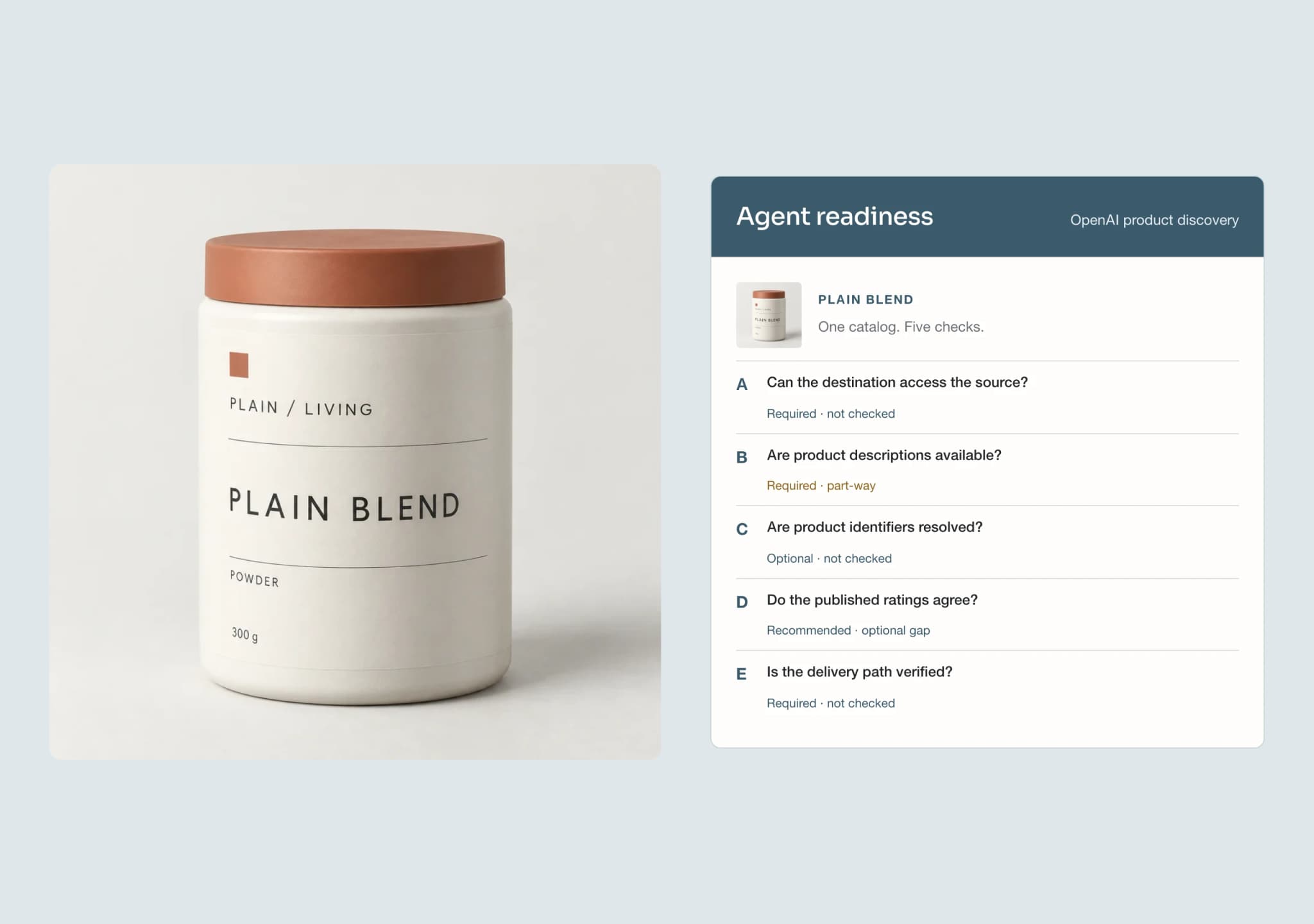
Start with one destination. Confirm its documented product requirements, feed schedule and merchant eligibility, then inspect the data it actually receives.
Check supported Product markup against the visible page. For Google rich results, use its Rich Results Test; passing that test does not certify eligibility on another platform or guarantee inclusion.
Use support tickets and reviews to identify unanswered purchase questions. Publish verified answers clearly, with links to their evidence where appropriate.
Then check, and write down the date and the exact prompt. Search for your products on Perplexity and ChatGPT. Absence has several possible causes and your structured data is only one of them, so treat a missing result as a prompt to inspect the record rather than as a diagnosis. If they appear but a competitor is recommended instead, compare your published detail to theirs.
Source: Google Merchant Center: About the Universal Commerce Protocol
What would this look like for your brand?
Talk directly with a founder about one customer journey, the systems behind it and a focused prototype using your approved products and content.