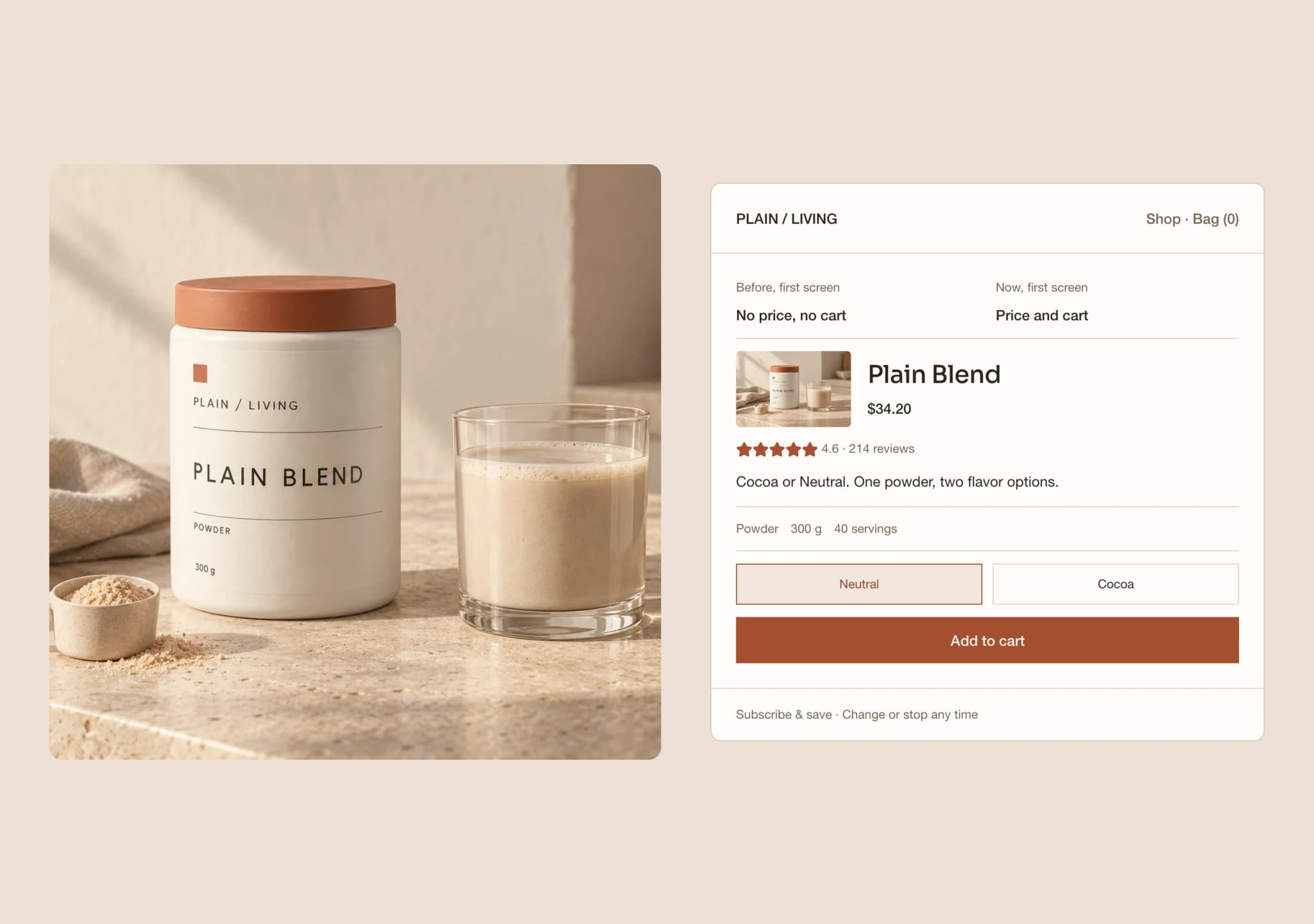
Concept Walkthroughs
Your question, not ours
 Ratik4 min read
A shopping assistant that opens with the store’s own question, shows the words it matched and the facts behind them, and ends on a starting point rather than a list.
Most shop assistants open with a question the shop invented. Pick a goal from eight tiles, choose a category, tell us your concern. That is a form with a chat window around it, and every brand has one.
The Assistant is a fictional concept built on a made-up store called PLAIN / LIVING. It runs a scripted matcher over a fictional catalog. There is no live model, nothing typed into it is stored or sent, and it gives no health advice of any kind.
Open with the question the store already asks
PLAIN / LIVING sells one powder, one capsule and one liquid. Its navigation is organized by format, which only helps somebody who already knows which format they want. The customer who does not know gets a menu.
So the assistant opens with the question the product pages already ask: how do you like to take it? Underneath it are four answers in a customer’s own words rather than category labels. I cannot stand swallowing capsules. I want the simplest possible routine. Something I can travel with. I just want to start somewhere.
Nothing there is invented. The question and the four answers come from the store’s own pages, which is the difference between an assistant that knows the shop and a chat widget bolted onto it.
Say what it will not answer, before anyone asks
The second message states the scope before anyone asks: formats, pack sizes and prices. Health questions need a qualified professional. The header opens a local explanation of human support; it does not connect to a person or send the conversation.
Type “Cocoa for allergies” or a question about sleep or immunity and it declines without a product plan. Known health terms are checked before catalog matching. This is a bounded set of scripted rules, not general health-language detection. Unsupported wording also gets no plan, even when it contains a catalog word.
This is the part that makes the rest usable. An assistant in a regulated category earns trust by being specific about its own limits, and the limits have to be visible before the first input rather than in a footer.
Show the words it matched
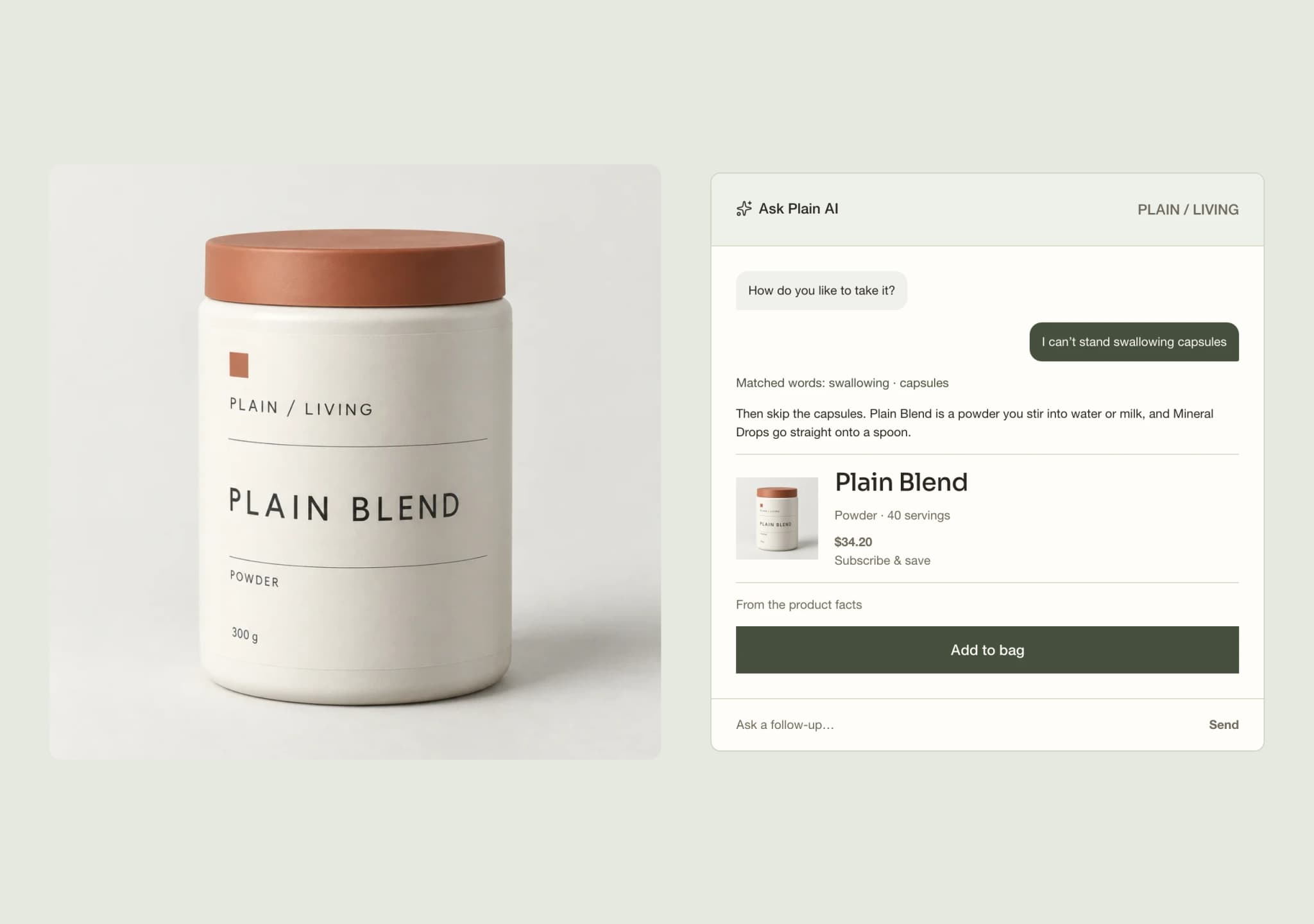
When the assistant matches a supported request, it first shows the actual terms found in that input. Then the reply. Then the published facts the reply came from, marked with the source. “Cheap” shows “cheap,” rather than a preset “price” label.
That sequence lets a visitor check that the answer follows from what they said, instead of taking it on trust. It also makes a wrong match obvious and correctable, which a confident paragraph with no working never is.
“I prefer capsules” selects Daily Essentials, while “I would like a powder” selects Plain Blend. The capsule-avoidance starter keeps its powder and liquid alternatives. An ambiguous request such as “capsules or powder” gets no plan. When nothing matches, the assistant says so and asks for one format or a starting question; it clears the proposed plan instead of choosing a fallback product.
End on a plan, not a list
A list of products is where most guided selling stops. The assistant ends one step further on: a starting point, then what works alongside it, each product named, priced, and carrying the reason it is on the plan. The total sits on the plan itself rather than waiting in a basket.
Every reason is a catalog fact. A powder rather than a capsule. Thirty milliliters rather than three hundred grams. The lowest price in the range. None of them says what the product will do, because the catalog does not say that and neither should the assistant.
What production would need
A real build starts from the store’s real catalog and its real question, and the matching gets harder as the range grows. A scripted matcher is the right first step precisely because it is inspectable: you can read every rule and see what it will never say.
Moving to a model changes the risk rather than removing the work. The content it is allowed to read has to be approved, the refusals have to hold under paraphrase, and the handoff has to reach somebody. What the assistant will not answer needs writing down before what it will.
An assistant that shows its working can be corrected. One that only shows its confidence cannot.
What would this look like for your brand?
Talk directly with a founder about one customer journey, the systems behind it and a focused prototype using your approved products and content.