Concept Walkthroughs
A count, then an estimate
 Ratik4 min read
An app for the days between purchases: remaining quantity calculated from saved usage, days left estimated at a saved daily rate, and delivery controls alongside an assistant that knows when to stop.
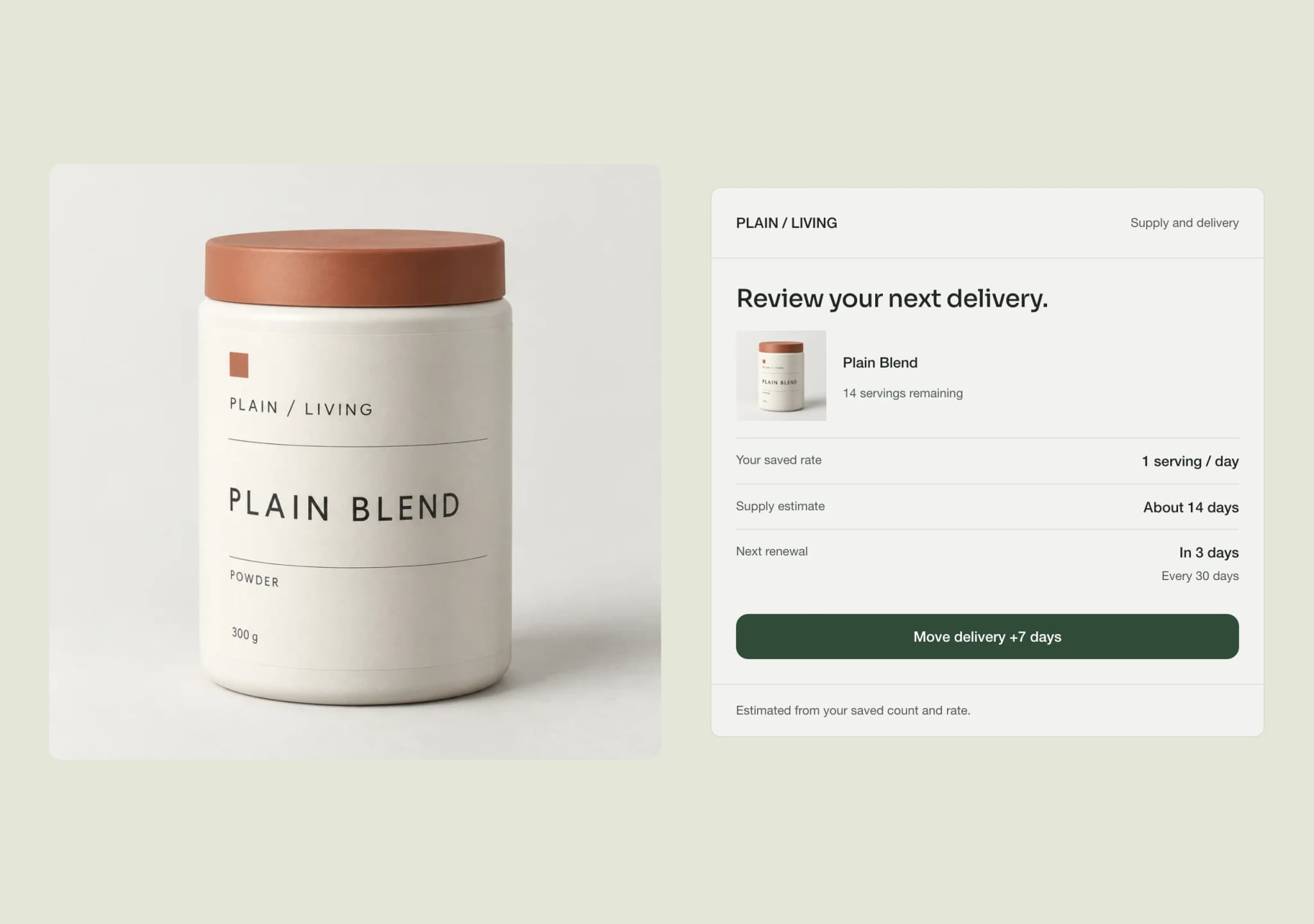
Most commerce apps are the website again, with a home-screen icon. The customer already bought. Opening it asks them to buy once more, and there is no other reason to be there.
The Supply App is a fictional concept built on a made-up store called PLAIN / LIVING. It runs on a fixed sample cycle rather than today’s date. Nothing is charged, no delivery is scheduled, no notification is sent, and no health advice is given anywhere in it.
Not a pill tracker
One possible direction is a tracker: tick off a dose every morning, build a streak, send a reminder. This concept takes a different direction: reviewing supply and managing deliveries without prescribing a routine.
The store publishes no dosage guidance and gives no medical advice. A customer-selected plan and self-reported check-ins need not prescribe product use. Supply focuses on saved quantities and delivery timing rather than providing use instructions.
Supply gives the customer something concrete to review before another order: what remains according to the saved inputs, and when the next delivery is due.
Three rows, each one a decision
The home screen is what is about to happen: a delivery arriving, a subscription renewing, a container running out. Each row is something the customer can act on in a tap.
Nothing there is a chore the app invented. These rows bring delivery timing and saved supply into one view; they do not establish what a customer has actually consumed.
A count, then an estimate
The label supplies the starting quantity, not the amount a customer has used. For Plain Blend, 40 servings minus 26 saved as used leaves 14. At a saved rate of one serving a day, that becomes about 14 days. The remaining quantity is calculated from the inputs; the time left is an estimate that depends on the rate staying accurate.
This concept uses fixed inputs, not live consumption tracking. There is no usage editor or automatic deduction as days pass. Mineral Drops has 6 ml remaining at a saved rate of 1 ml a day, giving about six days. It appears in the low-supply row because that estimate is at or below the configured eight-day threshold.
The row lets the customer add the product to the next delivery or review its timing without offering a discount. Whether that prevents a missed reorder or retains a subscription has not been measured. The reminder is only as useful as the saved inputs and delivery information behind it.
It does things
Ask when Plain Blend runs out and it answers with the saved quantity and estimated days. Tell it to push the delivery back a week and it moves the subscription date behind the card. This is a local change: nothing is charged or scheduled, and it can be undone from the same screen.
Moving a date, pausing and canceling are separate controls. The customer can choose the action that fits instead of sending a timing request to support. That is a control the interface provides, not evidence that it reduces cancellations.
An assistant that can only answer is a search box with a personality. One that can change something is worth opening.
And then it refuses
Ask whether it can be taken with a medication and it declines, says why, and explains the support route using Rae Okonjo, a fictional contact. Review the Support Handoff opens a notice explaining that this concept cannot contact anyone. No message is sent, and the concept promises no response time. Medical questions still need qualified professional guidance.
No medical advice and no dosage guidance is a line the store already holds everywhere else. An assistant that cannot say no is a liability on a supplement store, so this one is built to escalate, and the escalation is the differentiator rather than the fallback.
Naming the contact makes the proposed support route visible. Making that route real would require a staffed service, clear responsibilities and an agreed response time.
What production would need
Verified product quantities, a way to record and correct usage and daily rates, and real subscription and delivery integrations. It would also need a staffed support route with an agreed response time and notification rules tied to relevant events. Without accurate usage inputs, the app cannot know what remains in a customer’s cupboard.
It also needs measuring honestly. An app order is not automatically an extra order, and moving a purchase from the web to a phone is not growth. What the app should be judged on is whether subscriptions that would have lapsed did not, which is a comparison against customers who were not invited, not a total on a dashboard.
An app earns the home screen by being useful on the days nobody is buying anything.
What would this look like for your brand?
Talk directly with a founder about one customer journey, the systems behind it and a focused prototype using your approved products and content.